

For most of the last two decades, commercial AV ran on its own wiring: dedicated video cables, matrix switchers sized for a fixed number of inputs and outputs, and long point-to-point runs that were expensive to change. That model is giving way to AV over IP, where audio, video, and control travel across a standard Ethernet network. For IT directors and facilities leaders in Birmingham, Nashville, and across the Southeast, the shift brings real flexibility, and a new set of planning decisions.
This guide covers what AV over IP integration involves, where it makes sense, and what to settle with your network team before the first encoder goes in the rack.
What AV Over IP Actually Means
In a networked AV system, each source, such as a room PC, camera, or media player, connects to an encoder that converts its signal into network traffic. Decoders at each display or speaker zone turn that traffic back into audio and video. Instead of a fixed matrix switcher, the network itself becomes the routing fabric. Any source can reach any destination the network can reach, and adding a new display is often a matter of adding a decoder and a switch port rather than pulling new cable back to a central closet.
Where Networked AV Makes the Most Sense
Multi-room and multi-floor facilities that share content across lobbies, training rooms, and break areas.
Divisible spaces and training centers that reconfigure from one large room into several smaller ones.
Operations and command spaces that route many sources to a video wall and operator positions.
Distributed audio for paging, background music, and announcements across an entire building.
Organizations that expect to grow, where a fixed-size switcher would eventually run out of ports.
For a single huddle room, a traditional approach is often simpler and less expensive. AVX recommends networked AV where its scalability pays off, not by default.
Standards and Ecosystems Are Maturing
AV over IP is not one product. Dante is widely used for networked audio, and several video platforms use their own protocols. Interoperability is improving: the AIMS alliance launched IPMX as a fully developed open standard for professional AV over IP at ISE 2026, with certification programs following. For buyers, the practical question is less about choosing a winning standard and more about choosing a design that fits your bandwidth, latency, and integration requirements, and that your integrator can document and support.
Network Readiness Is the Real Project
The most successful AV over IP deployments start as a conversation between the AV integrator and the IT team, not as an equipment order. Before design is finalized, AVX works through questions like these with your network staff:
Will AV run on a dedicated physical network, or a separate VLAN on the converged network?
Do the switches support multicast management (IGMP snooping and a querier) and Quality of Service?
How much bandwidth will each video stream require at the resolution and compression you need?
Is Power over Ethernet budget available for endpoints such as cameras, touch panels, and speakers?
Who owns monitoring, firmware updates, and change control once the system is live?
Getting these answers early prevents the most common networked AV problems: streams that flood the network, video that stutters under load, and finger-pointing between AV and IT when something goes wrong.
Security Belongs in the Design
Every encoder, decoder, and control processor is a device on your network. AVX designs networked AV with your security policies in mind, including network segmentation, changed default credentials, documented device inventories, and firmware management. That keeps AV aligned with the standards your IT team already applies to every other connected system.
Infrastructure Still Matters
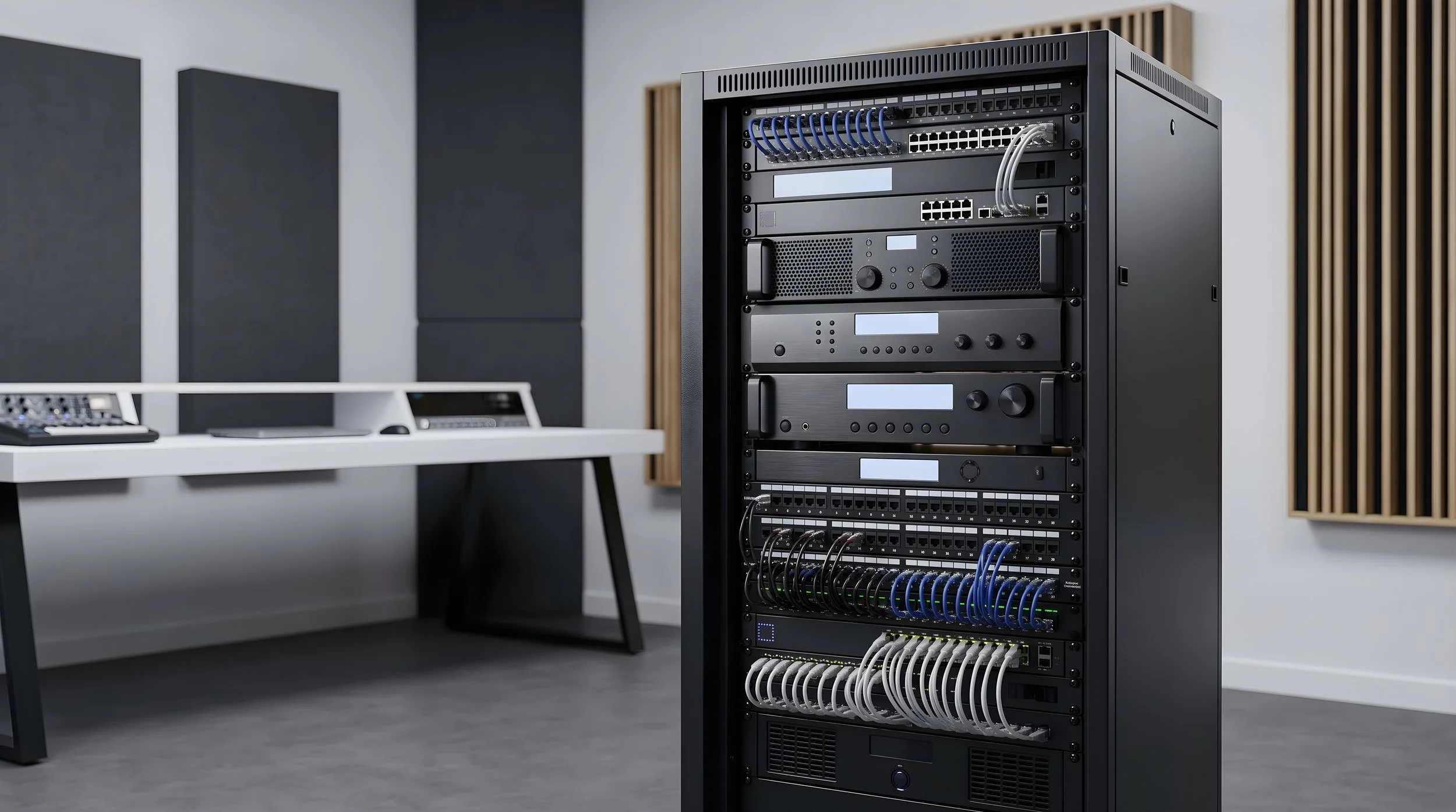
AV over IP reduces specialized cabling, but it does not eliminate the need for well-planned infrastructure. Certified structured cabling, properly ventilated equipment racks, and clean pathways remain the foundation. On new construction and renovations, AVX coordinates with architects, general contractors, and IT during design so network drops, rack space, and power are in place before walls close.
Control That Hides the Complexity
Users should never have to think about encoders or multicast groups. As a Crestron Master Programmer and Cisco Partner, AVX builds control interfaces that present networked AV as simple choices: show this source on that screen, combine these rooms, send this announcement everywhere. The flexibility lives behind the touch panel.
One Standard Across Every Location
For organizations with offices in Birmingham, Nashville, and Huntsville, networked AV makes it easier to standardize. A proven room design, configuration, and control layout can be replicated site to site, and AVX's certified in-house service team supports those systems directly, with no subcontracted callbacks.
Evaluating AV over IP for a new facility or upgrade? Schedule a consultation with AVX.